


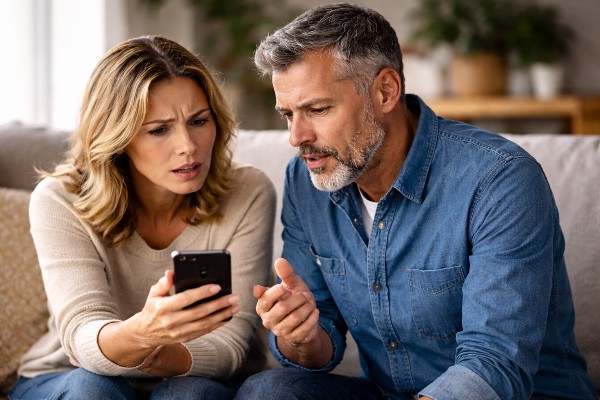
 In the modern era of dating and marriage, a new character has entered the therapy room: the smartphone. While technology allows us to stay connected across distances, it has also introduced a complex layer of friction that many couples are unprepared to navigate. In communication therapy, one of the most frequent hurdles we address isn’t what was said, but the medium through which it was delivered.
When it comes to the health of a relationship, texting is often a double-edged sword. It’s perfect for logistics (“Pick up milk?”) but can be disastrous for emotional nuance.
The Lack of “Non-Verbals”
The primary issue with texting is the absence of non-verbal cues. Research suggests that as much as 93% of communication is non-verbal, consisting of body language, facial expressions, and tone of voice.
When you strip away the warmth of a partner’s voice or the softening of their eyes, a simple sentence like “We need to talk” can transform from a neutral request into a terrifying ultimatum. Without these cues, our brains—specifically our attachment systems—tend to fill in the blanks with our deepest insecurities. If you have an anxious attachment style, a delayed response might be interpreted as a withdrawal of love. If you are avoidant, a flurry of texts might feel like an intrusive attack.
The “Asynchronous” Trap
Texting is asynchronous, meaning there is a gap between the message being sent and the response. This gap is a breeding ground for “projective identification.” We project our own internal state onto the silence.
In communication therapy, we often see the “Texting Spiral”:
-
The Trigger: Partner A sends an emotionally charged text.
-
The Silence: Partner B is at work or driving and cannot respond immediately.
-
The Escalation: Partner A, feeling ignored, sends three more texts, each increasingly more frustrated.
-
The Explosion: Partner B finally sees the messages, feels flooded and attacked, and responds with a “stonewalling” text or a sharp defensive barb.
Attachment and the “Digital Tether”
For many, the smartphone acts as a digital umbilical cord. For those with secure attachment, texting is a tool for “check-ins” that reinforce safety. However, for “mixed-agenda” couples or those in the pre-marital stage, the phone can become a tool for surveillance or a way to avoid the vulnerability of a face-to-face conversation.
Communication therapy encourages couples to recognize their Digital Attachment Styles. Do you use texting to “protest” (sending angry messages to get a reaction)? Or do you use it to “evade” (bringing up a difficult topic via text because you’re afraid of the real-life reaction)?
Rules of Engagement: Bringing Therapy into the Inbox
To prevent texting from eroding your connection, therapists often recommend a set of “Digital Fair Fighting Rules”:
-
The “Two-Text” Rule: If a disagreement isn’t resolved within two back-and-forth texts, the conversation must move to a phone call or in-person meeting.
-
No “Heavy” Topics: Never initiate a conversation about finances, family boundaries, or relationship doubts via text.
-
The “HALT” Check: Before hitting send on a heated reply, ask if you are Hungry, Angry, Lonely, or Tired.
-
Assume Positive Intent: In the absence of tone, choose to believe your partner is being neutral rather than sarcastic or mean.
Conclusion
Texting is a wonderful tool for “micro-connections”—sending a quick “I love you” or an inside joke. But it is a poor substitute for the deep, regulated, and mirrored communication that happens when two people look each other in the eye. By setting boundaries around how you use technology, you ensure that your digital life supports your emotional life, rather than sabotaging it.
